[tabs title=”” active=1 event=”click”]
[tab title=”General:”]
[hungryfeed url=”http://www.diigo.net/rss/user/Joesabado/blog_pln” feed_fields=”” template=”3″ link_target=”_blank” max_items=100]
[/tab]
[/tabs]
[tabs title=”” active=1 event=”click”]
[tab title=”General:”]
[hungryfeed url=”http://www.diigo.net/rss/user/Joesabado/blog_pln” feed_fields=”” template=”3″ link_target=”_blank” max_items=100]
[/tab]
[/tabs]
Two weekends ago, I went to the driving range and I was hitting the balls pretty well. Then I decided to get contact lenses the following Monday because I wanted to start playing sports again since my eyeglasses had became too cumbersome. Last Sunday, with my new contact lenses, I went to the driving range and all of a sudden, I could not hit any shots at all. My swing just didn’t feel right. As I would set up and look at the ground, something felt different. The clubs look different and it seems my depth perception has changed. It took me awhile to figure out what has changed until I realized it was my contact lenses that was the difference.
As I took a break from hitting balls, it dawned on me that this concept of changing my lenses at work led to changing my perspective. I don’t mean lenses as in getting new eye glasses or contact lenses. What I mean is more of a mental lens. Before my wife went for a vacation to Seattle the beginning of September, I was getting a little frustrated trying to figure out how to promote the use of social media and cloud. Because of security and policy concerns, there were (still are) hesitation on the use of these technologies as business tools. Taking the vacation provided me some time to clear my mind and put on a new set of mental lenses which allowed me to look at the situation a little differently. I came back with the perspective that while the adoption of these technologies might be slower than I would like, I understand that it is a process that requires examining constraints and having to accept that our organizational culture and personalities will ultimately dictate the pace of adoption. I also came to realize that I can continue exploring the benefits of social media and cloud on my personal time knowing full well that the knowledge I acquire now will be of value to my organization at the time we are ready to come to terms with the risks/rewards of these technologies.
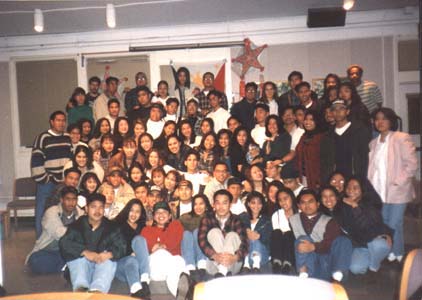 I will be attending a training session today to prepare for my role as a Transitions Course facilitator for STEP (Summer Transitional Enrichment Program), a summer bridge program for incoming first generation and under-represented students at UC Santa Barbara. I feel really privileged to be invited back for my second year as a facilitator. I attended STEP in 1991 as a student and I was also a Resident Assistant in 1994. For the past few years, I have supported the program’s technology needs which includes developing and managing an on-line application/registration system for students and a management system for the staff. With all the services and programs I have been involved with at UCSB, STEP means the most to me. This is what introduced me not only to the university and its resources, but it was also where I met some of my life-long friends. As I review the agenda for the training, I find myself reflecting on my experience in student affairs as a student who used the services, as a student worker in multiple departments and as a professional. I think about the significance of my job to me personally, what really drives me and why I enjoy it so much.
I really don’t know what makes a good student affairs professional or what makes one qualified to be one. I don’t have an advanced degree in this area so I certainly do not have the theoretical perspective on student development, administration and thorough understanding of historical background, amongst other areas. At times I feel inadequate because I don’t have the formal education so I read as many literature I come across with and I have several mentors to provide me perspectives. I have even gone through an entire list of readings listed in a syllabus for a graduate course in higher education administration. While I have thought of pursuing a Masters degree in Student Affairs, life and financial circumstances have not been so accommodating.
What I do know is that ever since I was a student in 1991 and when I became a professional as a student affairs webmaster in 1996, I have always enjoyed working with students, hoping to make a positive difference in their lives, and helping other colleagues in all areas of student affairs. Most of my colleagues at UC Santa Barbara and those I met in the social media world know me as a technologist because that is my current professional role and have been the last 15 years. A colleague told me once “sometimes we forget that you’re more than a techie, we tend to put you in the IT box.” I typically have not shared my experience as a non-techie in student affairs so I can’t blame them for putting me in the techie box. But as much as I love technologies and the satisfaction of being able to deliver web applications, vendor systems, technology delivery is not ultimately what I think what my job is. My job is student service.
What I find rewarding about student affairs is that I learn so much about so many different aspects of life, not just student life, but life in general. My role as a divisional level resource has allowed me to work with all departments in UCSB Student Affairs. For example:
Where I find most personal satisfaction is working with students and the other activities outside my technologist role. Serving in student fee advisory committee, student resource team, reading admissions applications, and serving as student organization advisor provide me with reminders of who I am ultimately serving, the students, and that I am able to somehow make a difference in their lives is what motivates me. As an aside, moving forward with new technologies like social media and mobile web, I have also found these activities very critical to my understanding of the culture and trends of students today.
The fact that I am able to enjoy a career that combines my interests in technologies and student affairs is a blessing I don’t take for granted. In my role as a leader in a central student affairs technology department, I do try to impart to my team members the perspective that we are student affairs employees and technology is what we contribute to our organization. In order for us to be effective in what we provide, we need to understand not only the business processes but the culture of student affairs in general and the sub-cultures that exist within each unit. I left student affairs 3 times in the past to pursue other opportunities but I ended up coming back. I am not sure what the future holds, given budget cuts and efforts to combine university units but what I do know is that to this point in my life, having a career in student affairs has been really great, professionally and personally.
“Patience is the key, patience is the key”, a fellow fisherman says repeatedly as he and I both tried to untangle our fishing lines this last weekend at a local pier. As I was listening to him utter those words, I realized there were some lessons during the 5 hours of pier fishing (mackerels) with my brother-in-law and my two nieces (ages 8 and 11) I could apply at work. It just proves the point, one looks hard enough and there are lessons to be learned anytime, any place. Here are some work lessons I was reminded of:
* Patience is the key when dealing with problems/issues, especially when dealing with others. If you have ever had the chance to go fishing and have your fishing line caught with another line(s), you’ll quickly realize that tugging and just randomly trying different ways to untangle can make the situation worse. As a matter of fact, the more tangled the lines are, the slower and more deliberate you have to separate them. This lesson is very applicable at work, especially when dealing with co-workers and customers. Sometimes, you just have to slow down and look at the issue you’re presented with and deliberately work together to get the issue resolved.
* Heartfelt praises go a long way and it doesn’t take any professional training to learn how to provide effective ones. My nieces were very excited about the fishing trip and all through out the 5 hours we were fishing, they were very vocal in their encouragements. When my brother-in-law and I would catch a fish, they’d yell “Way to go Uncle Joe!”, “Great job Daddy”, “Now we’re in business!” There were times when we didn’t catch fish for long minutes and they’d yell “Don’t give up Uncle Joe!”, “We’ll catch some more soon!” and when we’d catch a fish but would fall back in to the the ocean as we pulled it up, they’d yell “That’s okay Uncle Joe, we’ll get some more!” I think we could all need more positive feedback at work.
* Collaboration and defined system/role helps a lot to be efficient and leads to high morale. I had one of my nieces as my “assistant” while the other one was helping out her dad. They knew their roles and so when we brought up the mackerels (up to 5 at a time); they were ready to help us out by putting the fish into our buckets. They thought it was “yucky” at first but they didn’t mind holding the fish after awhile and they were more than happy to fulfill their roles. My brother-in-law and I both encouraged them many times, thanked them for their help and they really accepted their roles. In my career, the two major disputes I have had with my co-workers were because our supervisors did not explicitly define our roles and the ambivalent boundaries created tension because my co-workers and I did not know where we fit in. Actually in one of the case, my supervisor told my co-worker and me separately that we both had the final say in our projects, which we didn’t realize until we finally talked about our issues.
* It’s easier to work with positive people. My nieces could have complained about how cold and windy it was but they didn’t. They occupied themselves by playing; looking at other people’s catches and helping my brother-in-law take the fishes off the hooks and into our buckets. That’s the same way I feel when it comes to work. Workplace is so much nicer when surrounded with optimistic and appreciative co-workers. A big part of why I enjoy my work is because of the positive attitudes of my team and my customers.
If you ever want a place to have fun pier fishing, catching bunch of mackerels and learning some work lessons along the way, try the Gaviota State Beach off the California coast, 20 miles north of Santa Barbara.
Sometimes I think we only move forward and accept bigger responsibilities in our professional lives when we feel capable and confident, when we feel ready. I had a co-worker once who turned down a promotion because he felt he was not ready. How many of us never even bother submitting our job applications to a position we would like to apply for but based on the job description we don’t feel we won’t even be considered? How about not accepting a job assignment or an opportunity because we think we’re not capable and we are scared of failing? I still feel that way from time to time but looking back at my career, the greatest growth and greatest sense of accomplishments came when I decided to be bold and just accept the responsibility without thinking much of the consequences of failure. Let me give you three experiences that made a significant impact on my career. These are three instances that while it may not have been the brightest move, by stepping up and taking on the challenge, I was able to use them to grow as a person and as a professional.