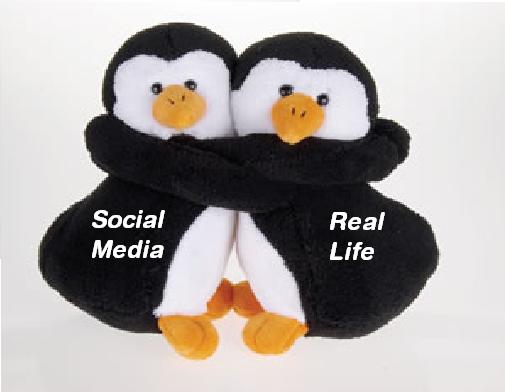
Social Media

Why Higher Ed IT Staff Should be on Social Media

I was talking with someone working in higher education IT a few days ago about social media and why I have embraced it. He told me  “No way will I be interested in social media. If you watched the movie Social Network,  you’ll know that Zuckerberg created facebook so his buddies could get laid.” He also told me “I don’t want to know what some mom cooked for breakfast.” So I asked him if he has a daughter and he tells me he does. I asked him “Who’s going to teach your daughter about how to properly use social media?” and his response was “Not me.” With the realization that I could not convince him about at least understanding social media and that they won’t go away soon, I changed the topic.  The negative attitude towards social media by some IT professionals is understandable given the security and policy implications. In some sense, social media also represents some loss of control when it comes to what and how technology should be used in the workplace.

Based on my short experience using social media, I would urge other colleagues who work in higher education IT to give social media a chance for the following reasons:

  • Keep up with trends. I have observed the following the last couple of years:
    • Increasing use of mobile devices on our campus by students and staff.
    • Increasing requests from departments we serve to use external software services for their business needs.
    • Increasing social media presence by campus departments, student organizations.

Before I started using twitter last year, I didn’t realize there was actually a term for this phenomenon and it is not unique to our campus.  This trend is called “consumerization of IT” and is defined on Wikipedia as “trend for new information technology to emerge first in the consumer market and then spread into business organizations, resulting in the convergence of the IT and consumer electronics industries, and a shift in IT innovation from large businesses to the home.”

  • Understand our customers.  How can we serve our customers if we don’t know their mindset and tools they use? By just observing the communication between students and our staff on facebook and the general conversations on twitter, IT staff can learn a lot about issues/trends that cannot be found anywhere else.
  • Professional Development. Every day I log onto facebook, google+, twitter, youtube, slideshare and other social media websites, I consider them as free learning opportunities. I have only attended 2 conferences the last 4 years due to lack of training budgets but I have used social media as my personal learning network (PLN) and have learned a lot about mobile web development, social media and leadership.  When I read blogs by experts in technologies and higher ed, I find insights than typical articles and websites would often reveal.
  • Be Relevant and credible. As more of our customers demand to use consumer technologies, inevitably, appropriateness and policy issues will come up for discussion.  Would I  really be credible as an IT professional if I don’t even know how these technologies work? Part of the reason why I spend so much time on social media is to research how they work and how they relate to our business, including what issues to consider. If I have to take the position of rejecting a customer’s proposal to use an external service, I want to be able to credibly tell them the reasons for my position. On the other hand, if I do approve their proposal, I need to be able to assist them in using the service that is consistent with university policies and in ways they may not have thought of.
  • Keep up or get left behind. I was told a year ago that social media is a fad and so is Skype so I shouldn’t bother investing any time/resources investigating it for business use. I was also told students do not use mobile devices. Ironically, part of what motivated me to be on social media is to find out for myself on whether what I am being told are actually true. Given the pace at which consumer technology changes, it is a challenge to keep up. I generally spend up to 4 hours most nights just learning new technologies including mobile web and social media and I still feel as if I am behind. In some ways, I consider the time I spend on social media as career investment. I don’t know what IT will look like five years from now but all I know is that the convergence of social media and the enterprise will be even greater than what it is today and I want to be in a position where my knowledge lie in both areas to be employable, competing against our current students who will have entered the work place and who have far greater knowledge about consumer technologies than I do.
  • Learn about hobbies, personal interests; connect with folks with same interests. While I hear stereotypes about IT folks as not being too sociable and have no lives, all the IT folks I work with have some outside interests/hobbies. I spend my weekends watching sports and it’s fun being able to watch the games with others that are in different cities, states and in some cases, other countries.

Social media definitely have some pitfalls but I think the benefits outweigh the risks. For anyone working in higher education, not just IT, the days of questioning the values of social media in higher education is long gone. If we are to stay relevant and provide quality customer service, we need to do our part to understand the current needs of our customers and future trends so that we are prepared to adopt them rather than reacting.

What other reasons should higher education IT staff be on social media?


The Pursuit of Community & Social Media

I attended the 1st Naspatech Conference in Newport, Rhode Island last week, along with approximately 170 other student affairs professionals and students. If there ever was an ideal conference for me, this conference was it.  It was a conference that discussed technology in the context of student affairs, a topic that interests me professionally and personally.  It was also the chance for me to meet those I have come to known and admire online via social media, in real life, for the first time.  It took me several days to digest the information I was presented at the conference, and there were certainly some ideas that really resonated with me. That emerging technologies like social media, mobile and cloud computing and their applications in student affairs dominated the conference was not really a surprise for me since I have been researching this topic for a few months now and in my professional role as a technology provider at UCSB Student Affairs Division, I have observed this trend for a few months now. I found all the speakers knowledgeable and interesting. However, one speaker that really impacted me was Kenneth Elmore, JD, Dean of Students, Boston University (@deanelmore). In a few words, Dean Elmore articulated what I think as to why I have been very passionate about social media. Dean Elmore talked about the idea of social media aid and the role it plays in the pursuit of community in his speech. What he said intrigued me and sounded familiar but I followed up with him via twitter after the conference and he this:

“I think the concept of community is elusive. The real joy and challenge is in the pursuit of it. Social media aids the pursuit. I also believe the element of the pursuit of community are: making intros; establishing presence; empowering users; keeping it cool; & music”

When I heard him talk about this idea of the pursuit of community, it dawned on me that this is what I had been doing at UCSB for the last 20 years starting when I entered as a freshman in 1991 and I was immediately embraced by other participants/staff of a summer program for first generation students and the Filipino American student community; what I continued to do as I turned professional in 1996; and is now my motivation for my interest in social media. Personally, social media provides me the sense of connection with others that share my interests, and beyond that, it provides me with a sense of purpose in being able to continually share and learn from others.  Because I see so much value of social media for me personally, I feel obligated to promote the use of social media to others and in my organization.

I view social media from multiple perspectives including, but not limited to: 1) as a technology service provider, 2) as a UCSB community member and 3) as a student affairs professional including as an org advisor/mentor to first generation and minority students.

As a technology service provider, I see the value of social media as a communication channel to exchange information with our customers, to market our services, but more than that, I see social media as a way for students to build communities. When students are now able to build relationships with others before they even step foot at UCSB; when they are able to share their fears/concerns/excitement/anticipation as they transition from high school to this unfamiliar world of college life; and when they are able to support each other in their academic and social lives at UCSB, how does anyone measure the value of that? The measurement goes beyond numbers and economics.

A couple of days ago in a conversation about social media, I mentioned that if I wanted to know what events are going on at UCSB, I go to facebook. The value of facebook goes beyond just knowing what events are happening for me as a UCSB community member. I appreciate being able to see some aspects of my colleagues lives  beyond what I know of them from going to meetings, and working with them on projects. I have been really pleasantly surprised to see their interests beyond their professional lives and the additional roles they have as parents, partners, children, etc.

One aspect of my professional experience the last 15 years I really enjoy and find great personal satisfaction is the privilege of being an advisor to student organizations and mentor to some students. While I am not as involved as I used to be in previous years due to the fact that my wife and I now commute limiting my involvement, social media does provide me with a way to connect with students.  For the last two summers, I have been a facilitator for a summer bridge program for incoming freshmen, the same program that provided me the community that helped me in my transition to UCSB. I have been able to maintain my connection with the students enrolled in my class after the program through facebook.

As I think about my wonderful experience at NASPATech conference and meeting folks I had only previously met via social media (#sachat on twitter) as well as those who I met at the conference for the first time, what if I had decided to not create my twitter account on August 9, 2010?

What’s your experience with social media in terms of community building?


Digital Trends

[tabs title=”” active=1 event=”click”]
[tab title=”General:”]
[hungryfeed url=”http://www.diigo.net/rss/user/Joesabado/blog_digital_general” feed_fields=”” template=”3″ link_target=”_blank” max_items=100]

[/tab]

[tab title=”Higher Ed:”]
[hungryfeed url=”http://www.diigo.net/rss/user/Joesabado/blog_digital_hied” feed_fields=”” template=”3″ link_target=”_blank” max_items=100]

[/tab]


[tab title=”Digital Identity:”]
[hungryfeed url=”http://www.diigo.net/rss/user/Joesabado/blog_digital_identity” feed_fields=”” template=”3″ link_target=”_blank” max_items=100]

[/tab]

[tab title=”Social Business:”]
[hungryfeed url=”http://www.diigo.net/rss/user/Joesabado/blog_socbiz” feed_fields=”” template=”3″ link_target=”_blank” max_items=100]

[/tab]

[tab title=”CoIT:”]
[hungryfeed url=”http://www.diigo.net/rss/user/Joesabado/blog_coit” feed_fields=”” template=”3″ link_target=”_blank” max_items=100]

[/tab]

[/tabs]


NASPATech – A Student Affairs IT Pro’s Perspective

Photo courtesy of Eric Stoller (http://ericstoller.com/blog/category/technology/)

I have a job that combines two of my interests – student affairs and technology and the NASPATech conference is the only one I have ever attended that combines both. I have been to technology conferences but never in the context of student affairs.  I am excited to meet the folks the student affairs professionals and students I have met through social media (twitter via #sachat, #satech, facebook, and linkedin) in real life.  I am also excited to learn how other organizations and professionals utilize technology in student affairs beyond the IT perspective.  While my formal position is in IT leadership, I do consider myself as a student affairs professional first who works with technology and not a technologist who works in student affairs, having spent almost 20 years in students affairs in multiple capacities, including non-technical roles.

In this transformational period in higher education when technology has become an integral part of every function in the university and consumerization of IT has changed the technology landscape, the role of IT department and professionals are changing. In addition to the role of technology providers, IT departments must now play the role of brokers, playing the role of consultants between departments and vendors, campus units within and outside of student affairs as the push for combining services to cut cost continue, and with other campuses as collaborations between campuses expand. In addition to having to adopt a new role, there is also the challenge of having to keep up with the faster pace at which technology is introduced and the expectations of our customer that go along with it.

IT is often recognized as a utility, providing the network/server infrastructure, software and services. Given the scarce resources and dwindling budgets, the challenge of “keeping the lights on” by providing reliable and secure services while being innovative is very difficult. However, in my opinion, IT must go beyond being a utility provider and become a strategic leader by embracing new technologies and practices along with the expectations/attitudes and apply them in the context of the mission of our university and student affairs. To be able to do this, IT leadership must not only continue to understand the current/future needs of  our customers, but to also learn from the experience of others,  and to be aware of relevant technology trends and consider them in our strategic planning.

When NASPATech was announced a few months ago, I was not sure if my department would have the funds that would allow me to attend the conference and so I offered to review some program proposals. I also spoke with Joseph DeSanto Jones who was kind enough to spend some time sharing the purpose of this conference as well as to listen to my thoughts on student affairs and technology. I realized after reviewing the proposals and from my correspondence with Mr DeSanto Jones that this conference was too important for me to miss. I wanted to come, not only to meet the folks I’ve met via social media, but also to understand the current/future needs of our customers, learn from the experience of others, and to be aware of future trends.

For those at the conference, I would love to be able to share our experience/ideas on student affairs, either technology or in general. Whether you’re here or joining us via social media backchannels, what would you hope to get out of this conference?


Less Tweets, More “Face-to-Face”

Courtesy of My Accidental Muse

Update:  Online experience is “real life” so I’ve come to use the phrase “face-to-face” instead of “in real life.”

I was checking my twitter timeline on my way from the airport to my hotel in Newport, Rhode Island for the NASPATech Conference when I realized I was missing out on the experience of seeing this new place for the very first time. While it was late at night and it was hard to see outside from the shuttle van, it was an experience I told myself I should not be taking for granted.

At that moment of realization, I put my iphone away and started a conversation with the driver, talking about the signs on the roads and how I noticed that Newport seems to be surrounded by water. I learned some things about him like he used to live in Orange County in California but he was born in Massachusetts.

I know some folks at this conference via twitter and I’m thankful for being introduced this way. I will make the effort however to make sure to have more  conversations rather than tweeting and looking down my iphone, missing the experience of meeting these folks in real life.


  • Archives

  • Copyright © 1996-2010 Joe Sabado - Higher Education & Technology Leadership. All rights reserved.
    iDream theme by Templates Next | Powered by WordPress