Social Media

Why We Need to Redefine “Face to Face” Communication

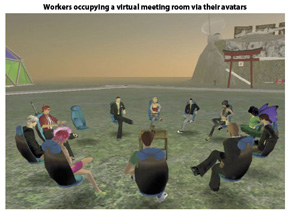
Virtual Meeting with avatars

credit - internetsiao.com

A story about a tech firm CEO banning the use of email for internal communication has been a topic of discussion around social media the last couple of days. Reported by multiple news agencies and websites, the title centers around the idea of “banning email” which is certainly a more sensational headline than the the fact that as the story notes,  “instant messaging and facebook-style interface” is replacing email for internal communications in the company.

This story reminds me of how in the last few years, some of the ways we, in our higher ed, communicate have changed. In addition to email and phones, instant messaging and video conferencing have become additional means to communicate in our daily work.  A few years ago, when we say face to face communication, that most likely meant two or more people looking at each other in the same physical room.

The concept of face to face communication is particularly relevant in student affairs and how we conduct our work.

I have heard some concerns about role of technology in how we interact with students and colleagues and how technology cannot/should not replace face to face interactions. However, our definition of face to face will probably have to change moving forward. Consider that some of our online students may never step onto our campus or that we will need to meet with students like international/out-of-state students before they even arrive on campus. With bigger bandwidth and the availability of wireless networking, face to face communication now carries a different meaning, to me anyways.

With Google+ Hangout, Skype via Facebook and other various free services available, the use of video conferencing for one-on-one and group communications will continue to become a bigger part of how we all communicate. Here are some examples I have seen video conferencing used on our campus:

  • My team of developers located on our campus use their webcams and Microsoft Communicator/Live Meeting to communicate daily with a couple of their colleagues who telecommute from different cities
  •  Our Admissions office staff use Adobe Connect to hold one-on-one and one-to-many virtual advising sessions with prospective students
  • A professor uses the same product to hold review sessions with his students
  • I had an informational interview using Skype and iphone with a graduate student from a different state
  • Students use TokBox to have multiple conversations
  • Video interviews of job applicants
  • A presentation on Identity Development Theories by a professor from San Diego State University to undergraduate students
  • Vendor presentations

A decade ago when the web became an important part of how we communicate with students,  along came  expectations of information/services available 24×7 and universities had to accommodate them. In these days of social media and more advanced technology, which include 2 way video communications, students will probably start expecting universities to use the tools and communicate they way they do in their personal lives.   In the future, what students define as face to face communication may be different than what we used to define it pre-social media days.

How do you see the way we communicate in our workplace  changing now and in the future?



A Hello/Tweet Could Just Lead To A Connection

I wonder how many interesting conversations and start of connections we miss by simply not saying “hi” to a stranger. I make small talks to strangers many times and most of them last just a couple of exchanges. However, some of my most interesting and enjoyable conversations I’ve had online and off started with just a simple comment or a question.

Last night, a simple “hello” and “where are you from?” from me to a stranger at a sushi bar led to  spending about 30 minutes talking with someone who is a family friend of Alex Smith, the 49ers quarterback. He was also teacher at the high school Smith and Reggie Bush attended. As a football fan, specifically Alex Smith and 49ers, it was a really fun conversation. When I went to Rhode Island for a conference last month, I had a lot of fun getting to know the van driver. I learned a lot about him and he provided me some history of that state as we drove by the area. A simple “It’s hot today isn’t it?” question to another person while we’re waiting to cross the busy bike paths at UCSB led me to about 15 minute conversation after realizing that we have a common friend, a friend I’ve known for the last 20 years. I also found out that he was the father-in-law of a nephew I had just recently re-connected with at that time. When I’ve traveled to different cities in the past, some of the most memorable experience I’ve had were those conversations I had with those I met at restaurants, in cabs and in New Orleans, a friendly homeless person in the middle of the night on my way back to my hotel room after dinner.

The connections I have made with few folks online started with me making the first tweet or some folks welcoming me to their online community. One community in particular I’ve found to be very welcoming is #sachat – a group of student affairs and higher education professionals. I’ve even met some of them in real life and they are just as welcoming and friendly as they are online. It’s amazing how my short  twitter experience of just a year which led me to professional connections just started with a tweet or two.

As someone who is still relatively new to twitter, I am always appreciative when someone who is relatively new or those  I only read about and follow like @briansolis, @marismith and @scobleizer, @askaaronlee take their time to respond to a tweet of mine or even follow me back. Mari Smith tweeted me back after I thanked her for acknowledging my tweet with this – “I love to treat all peeps as equals. Everyone is important to me.:)” With this attitude, no wonder she has garnered many followers. Likewise, I also respond to tweets, even just to start a connection. Yes, these tweets may only be a few words and the follows may seem trivial, but they could be start of a connection and interesting conversations.

Do you have similar experience to share? I’d love to hear them.


Maintaining the Core Mission, Keeping Up With Trends

The mission statement of the UCSB Division of Student Affairs, the organization I work for, has not changed since 1996, as far as I can tell.  Earlier this evening, I was looking at the original website for the division I created in 1996 via Wayback Machine and noticed the exact mission statement we have on our website now.  While our core mission has remained constant, the ways our various units and the division conduct our business have changed throughout the years. Shaped by technological advances including the internet,  infrastructures (virtualization, storage, networks), development tools,  as well as budgetary constraints, mandates and the demands of our students,  I think it’s safe to say our organization went through (and still going through) a technology (r)evolution.  My organization, in my opinion, is an example of how an organization can evolve and keep up with trends while maintaining its mission. This is not to say that keeping up with the trends has not had its challenges and resistance, but guided by the principle of innovation set by our Vice Chancellor for Student Affairs Dr. Michael Young, we have been generally successful. When I started as a web developer in 1996, Dr. Young shared with me a principle I have used throughout my career. He told me “I’d rather have us moving forward and make mistakes along the way than to stagnate.” This is the same principle that has allowed our division to commit to technology as a key component of our division.

Throughout this period of transformation, I have seen the adoption of new technologies in virtually all aspects of our organization.  Just recently, I compiled a list of the systems (pdf – 4.55 mb) we have developed and implemented throughout the last 15 years along with some legacy mainframe applications we still support.  The more than 120+ information systems/web sites are products of a commitment towards technology that the leaders of our organizations made 15 years ago.  Some of the notable systems in our portfolio include:

  • Integrated electronic medical system consisting of several vendor solutions for  our student health service and counseling services
  • Enrollment management systems including online application status/statement of intent to register, electronic grades submission, academic progress, online application review, online catalog, course enrollment, document management system
  • Student services systems including disabled student program online system (notetaking, proctoring management), alcohol/drug program enrollment management, online advising notes system
  • Online events ticketing, recreation program integrated system including online course enrollment

A part of that commitment is to create a central computing department within the division which grew from approximately 5 staff to more than 40 today. The organizational chart has changed several times throughout the years to respond to the changing priorities and needs.

As the trend towards greater adoption of consumer technologies (social media, cloud, mobile) in student affairs continues, along with the increasing budgetary constraints, changing student demographics and greater financial burdens to students, our organization is now having to adapt to the expectations of our socially networked and mobile students.  This requires a move towards social business, integrating social networking technologies as part of our business processes.  As it was in 1996 when web became a serious business tool in our organization, it took some time for the entire organization to recognize the value of the web. A conclusion I’ve come to given my experience throughout this technology (r)evolution is that the pace of innovation moves at the speed of the organization. Undoubtedly, our organization will continue to remain dynamic and accommodating to new trends consistent with our mission.


Social Media Is not All About ROI, It’s About Community

courtesy of http://www.mediaite.com

The UC Davis incidents which included a campus police casually pepper-spraying a group of student protesters and students using silent protest as a response to the UC Davis Chancellor illustrates the need for campuses to formally adopt social media to communicate. More importantly,  social media is needed to provide a venue for their communities to express and process their emotions and thoughts when events so shocking as this event requires communities to come together, to have dialogues.

I  was shocked, upset and disappointed at what had happened and as an employee of the University of California system, I was embarrassed and thoughts of “those could have been one of the students I know” and questions like “How can we avoid that from happening at UCSB?” and “What are our campus administrators doing to prevent this from happening?” came to my mind.  I also wanted to know what students are thinking and how they are reacting to the events. I couldn’t wait for campus assemblies few days later to process what I was feeling and to hear what others are thinking. I needed to find and share information and I needed to connect with people that could relate to my perspectives, those who work in higher education, in the UC system, in student affairs, those who work with students.

Throughout the weekend, I had short exchanges with folks I have met online via twitter and facebook.  I found information from blogs, videos from youtube by those who were at the event and who witnessed them firsthand. I found out about UC President Yudof’s response and his plan to meet with every UC Chancellors to discuss how to implement system-wide policies on how to properly respond to these types of incidents. I also found via twitter from a former UC employee that this was not the first time pepper-spray had been used at student protests and that at UC Davis, one student wrote about “administrators, students and police have been coordinating an under-the-radar response team to infiltrate student protest groups, relay information to administrators and police leadership and control peaceful gatherings in response to tuition spikes and budget cuts.”

What I had wished during the weekend was more connections with my  fellow UCSB colleagues, students and those that can relate to me. Believe me, those like me who have the need to connect online will use social media, with or without university approval.  In these times of crisis, universities really need to understand the need for two-way communication and to have avenues for their communities to be able to process their thoughts and provide outlets for dialogues. For those still seeking some kind of  quantifiable metrics to justify the use of social media, how about the fact that sometimes, it’s not all about ROI.


Using Social Media/Technology to Assist International Students

This post is about how technology, including social media, can facilitate the adjustment to the culture, lifestyles and academic challenges faced by international students new to this country. I was at a meeting last week for student affairs managers at our university and one of the topics presented is the increasing population of international students.  The increase in the population could be partly attributed to the active recruitment of our admissions officers in other countries. According to this article by LA Times, the University of California system made the move to recruit more out-of-state students, including international students for geographic diversity and revenue. The unique needs of the international students were also discussed. Some of these challenges include:

  • Constant process of values, beliefs, and ways of life from the moment they arrive without traditional support network.
  • Those for whom English is a foreign language, there is a need for time to adjust and the need for support system.
  • The classroom style wherein the expected active class participation may run counter from their native educational systems.  Specifically, asking questions to the professor may be perceived as being rude.

As I was listening to these challenges, I could not help but reflect on how technology can provide assistance in the transition process of these international students. What resonates with me are  1) the need for a community and support system before they even arrive and during their stay and 2) the need to accommodate the different classroom participation style. As noted in that meeting, the students may know the answer but they may not verbalize them. The list of technology-related ideas below are very limited but they could certainly be components of university efforts to ensure the success of the transition process and retention of international students. In addition, the mention of the products/services below does not imply endorsements but to illustrate what are currently available to my knowledge.

  • University sponsored/managed social networks. While any individual can create groups and pages on facebook, I think colleges and universities should be proactive in setting up, managing and participating in their networks which could include groups, pages and apps within facebook like Inigral Schools App.  There is a lot of value in having students connected virtually, months before they even arrive on campus. Our campus does use Inigral Schools app and from personal observation, I have seen students introduce themselves to others and have conversations on topics that are not even related to academics but rather on similar interests, experience and similar location of origins. During the summer when orientation sessions were happening,  students asked details about what to expect from those who have previously attended them. Additionally, some students who attended the same sessions planned meet ups as well. Towards the beginning of the school year, topics discussed include items to bring for their dorms, class information (including common schedules), and plans to meet up for various activities (running, gym, surfing).
  • Social Media/Mobile for academic use. While the notion of using social media and mobile for academic use, particularly within classrooms as a means of participation is still not universally accepted, I think there is some value to providing alternative methods of engaging international students beyond verbal participation. There was  a study by Dr. Rey Junco that showed the use of twitter in the classroom led to an increase in the engagement and higher semester grade point average for students.  A good example of a system that uses social media and mobile for academic use, including active participation in the classroom is Studio by Purdue. From personal observation on facebook, I also see students collaborating on homework and forming study groups.
  • Personalized online orientations. One of the challenges for international students who are not familiar with the English language during orientations is that they may not be able to keep up with the presenters and comprehend materials being presented. In some cases, they are not able to attend these orientations physically. I think making these presentations available on-line, including one-on-one sessions using software like Adobe Connect, Skype and even Google+ Hang Out which makes these orientations more personal would probably make a difference in having international students feel more comfortable and understand the materials being presented to them.  In addition, general orientation sessions could also be recorded using software like Adobe Captivate and made available on university websites for later viewing.

What other ideas can you think of that could assist the transition (and retention) of international students?


  • Archives

  • Copyright © 1996-2010 Joe Sabado - Higher Education & Technology Leadership. All rights reserved.
    iDream theme by Templates Next | Powered by WordPress
