Don’t Take Yourself Too Seriously


image by Keri Bradford

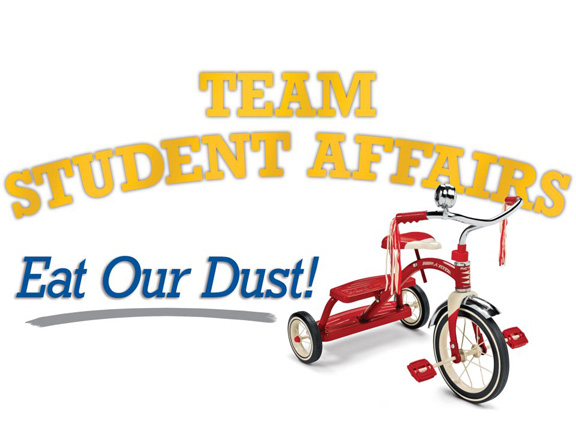
When I was asked earlier this week to participate in a tricycle race as part of a fundraising event at UCSB, I didn’t think about it too much and I just accepted the offer. I’ll be a member of the Student Affairs team led by our Vice Chancellor for Student Affairs Michael Young. Truth be told, I haven’t ridden a bike in 20 years, definitely not a tricycle.  I’m probably the least fit amongst those participating and I will probably embarrass myself in front of many campus colleagues.  I really don’t mind that part. I just hope I don’t lose the race for the team:)

I think if I had been asked few years ago, I probably would have refused as I would have been too self-conscious about how I would look in front of others. One lesson I’ve learned as my career progressed is not to take myself too seriously. We work in hierarchical organizations dictated by titles and as I got promoted, I made the mistake of thinking the higher in the organization, the more serious, the more formal I had to be. I felt like I had to be perfect.  I used to take criticisms for my “shortcomings” very hard. It became too hard for me to be serious all the time, that just isn’t me.I had to go back to who I think I am, someone who just wants to go through life enjoying it, one who makes mistakes occasionally.

Sometimes, we just have to let loose. There’s a certain sense of freedom that comes in being able to make light of our ourselves. Will my colleagues think any less of me when they see me trying my darn best (comically) to pedal this little tricycle? I doubt it.


Listing Technology on Your Resume – An IT Manager’s Perspective


credit - monster.com

I initially hesitated to  comment on Ed Cabellon’s blog post “Listing Technology on Your Student Affairs Resume” because I wasn’t quite sure how resumes for IT positions differ from student affairs positions.    I do think there are general considerations applicable to both and so this post is to offer an additional perspective. Purely from my perspective as a hiring manager in a student affairs IT department and limiting the conversation to the technology portion of a resume, here are what I look for:

* Context of how an applicant used the technology. This means numbers and scope. Designing an application used by 2 people is different from designing a system used by 1000 people.  A list of technologies are good, putting some context behind the experience is even better. It helps to see specific versions of software and/or programming language(s) used.

* Experience with technologies relevant to the position. Listing technologies used 20 years ago is irrelevant. For example, if we are looking for a SQL Server database developer and I see FoxPro as the only database experience listed, that’s probably not a good fit. In addition, I think it’s probably acceptable to list other technologies like web development software, social media, desktop publishing as secondary information and they do not take focus away from required technologies to the position.

When interviewing an applicant, here is what I expect:

* I expect an applicant to be able to describe what the task/problem the technology solved, how technology was used. I also would expect them to describe their role(s) and their use of the technologies including from the context of business perspective.

* Instead of asking questions like “describe how you would use this tech?” I ask “how have you used this tech?” What I’ve found is that even applicants who list certifications like MCP, MCSD, etc, when asked practical questions, sometimes cannot answer questions that I would assume are fundamental knowledge. In other words, I obviously want to know that an applicant has some foundational understanding of how/when/why to apply technology but I also want to know that they’ve had some experience working with them.

* Do not misrepresent your level of experience. After having reviewed hundreds of resumes and interviewing applicants, I have found it easier to determine whether an applicant’s resume matches his/her actual experience during their interview.

The required level of experience and skill set vary based on the classification of the position we are trying to fill. My general advice is to represent your experience to match the job description and requirements for the position. In my career, I have been a developer, project manager, department manager and now a director. When the position I am applying for is a software developer, I would highlight my software development experience. As a matter of fact, if an applicant is applying for a software developer position and all I see is management experience, I would question whether the applicant is actually a good fit or if they’re even competent for the position.

When determining an applicant’s level of competence, motivation and fit with an organization, there are other evaluation processes that could/should be used including reference checks, questions about soft skills and coding exercises.

What’s your perspective on my thoughts above? Any other considerations to add?


Student Affairs Graduate Programs and Technology

Eric Stoller wrote a blog post about the topic of  student affairs graduate programs and technology on InsideHighered.com. Specifically, he wanted to know which graduate programs are leading the way when it comes to including technology in their curricula.  Below is the comment I shared coming from someone who does not have a Master’s degree in Student Affairs but does have several years of experience working from both the functional and IT sides of student affairs.

=============================================================================

Thanks for asking this question Eric. The topic of technology in student affairs is indeed very big and as you pointed out, bigger than social media. To get an idea of what technologies are used in student affairs, here is the information systems portfolio (http://sist.sa.ucsb.edu/Portfolio.aspx) of the central student affairs IT at UCSB where I work. I apologize that this is still in pdf (for now).

There are aspects to technology  that should be studied including policies, practices, staffing and the technologies themselves. Dr.Will Barratt from Indian State University wrote about the topic of Managing IT in Student Affairs in May, 2001. Here’s the article: http://studentaffairs.com/ejournal/Spring_2001/will2.html.

Leslie Dare, the Director of Student Affairs Technology Services at NC State University discussed the topic of Technology, Student Affairs and Graduate Programs on Highered Live with Eric himself  – http://higheredlive.com/technology-student-affairs-and-graduate-programs/. She actually taught a course on Technology in Student Affairs as well. Here’s the description – http://www4.ncsu.edu/~ladare/eac595/.

I don’t have a Master’s degree in student affairs, so I can only offer my perspective from my several years of experience in both functional and IT units in student affairs. Please take my perspective with a grain of salt.

What I think should be considered as an approach in student affairs graduate programs with regards to technology is to examine technology in the context of theoretical frameworks and practices and apply them in what I consider realities of today (changing demographics, advancement in technology, budgetary constraints). I think this perspective is similar to Kevin Guidry’s point.

I work full-time in IT and I even I don’t have enough time to learn all the different areas such as database management, server/network support, security, procurement, accessibility and software development. These areas don’t even include having to learn emerging technologies, which in my case, I spend time learning at night. I wouldn’t expect practitioners to spend their time learning all these technologies in addition to the demands of their business duties. The question of how much should practitioners know to be considered competent is another topic in itself.

From an IT perspective, what has been really helpful when working with functional units is when practitioners have been able to articulate their business processes/needs, the “why” questions/answers.  If they can provide us with some ideas on how to build it, even better, but not required. I think as technology becomes even more significant in student affairs, more so than today, practitioners who have the knowledge in business process analysis, on top of practical experience/understanding of theoretical frameworks will be the ones in demand. Regardless if the technical solution sought is to be developed by IT, bought from a vendor, or utilize free services on the web, there is still the need to understand how these solutions would address business needs. Let’s take social media. I think it’s just a matter of time when student affairs will start to adopt social media for other uses beyond marketing and engaging with customers. I can see student affairs using social media for operational and student service uses.

Personally, I’ve always relied on the knowledge of our functional units to guide my team and I in how to approach a technology solution. There’s the ideal technical solution that IT may want to build and provide but then there’s the solution(s) that meets the realities and demands of day-to-day activities.

Kevin Guidry shared his research on the history of technology and student affairs with me months ago and it is interesting that given the significant role of technology in student affairs throughout its history that we’re still asking this question.

As an aside, I had also asked some feedback on twitter, facebook, google+ andlinkedin asking how student affairs practitioners use technology in their line of work. Unfortunately, I only received 10 responses. I’m left wondering too if it was wrong timing, the topic is not interesting or I just posed the questions wrong. In any case, If you happen to be reading this, I would love to have some of your time to answer a few questions here: https://joesabado.com/articles/technology/student-affairs-technology-questionnaire/.

thanks:)
Joe

What Are Your Self Limiting Beliefs?

I grew up believing that “challenging” authority (elders, teachers, bosses) was considered rude and disrespectful.  By default, those in authority should be respected. I went through half my life, even early on in my career following orders and keeping my opinions to myself because of this belief. I was not supposed to “make waves” as their are consequences. I think I have come a long way from that person who was too polite to voice his opinions.  It took me some painful experiences to realize I had to change my way of thinking. Whether these self beliefs from personal experiences or imposed by society, I think there’s value in re-examining our own self limiting beliefs for a more fulfilling life.

In his book Awaken the Giant Within by Anthony Robbins, he shared some stories of self limiting beliefs.  One example are adult elephants that are physically capable of breaking away from a chain links tied to posts but they don’t do so. This is because as young elephants, they were tied to the same chain links and when they tried to break away from them, they were not physically strong enough and so growing up, they were conditioned to not even try. How many opportunities in our lifetimes have we failed to take advantage of because of our own self limiting beliefs?

Roger Bannister broke the four-minute mile barrier on May 6, 1954. For years prior to that date, the general belief was that it was impossible to accomplish that feat. Thousands of runners have run faster than Bannister since he broke that barrier. As I read somewhere, “everything is impossible, until it is possible.”

As a student affairs professional, I wonder what self limiting beliefs we have as a profession that maybe preventing us from advancing, looking at our profession in a different light? In my role as a technologist intent on promoting the use of mobile web and social media, one of the biggest push back against using these technologies are the fear of potential FERPA/HIPAA violations, security breaches, disclosure of confidential information. As someone who is in the position of responsibility to enforce policies and guard student records as well as other confidential information, I am very aware of the consequences, including penalties that could result from these incidents. I remember having the same concerns expressed to me in mid 1990’s when I started building web sites or when email became the primary form of communication. I also remember a colleague who refused to acknowledge the possibility of using the web to conduct financial aid transactions because he felt the web will never be as robust as desktop applications.

New technological advances bring higher expectations from our customers for our institutions to provide services the way they are accustomed to getting in their personal lives via consumer technologies.  How long, as a profession, can we continue to cling on to our self limiting beliefs of “that’s how we have always done it” or our skepticism against new ways of providing services to our students?

At a personal level, what are some beliefs you may have that are self limiting? How about student affairs?


A Defining Moment In My Career

There have been several moments in my career that I could call defining moments. These are moments that led to personal and professional growth, or just helped me shape my perspectives.  What I am about to share is one of them. It was a reminder that looks do matter, my skin color matter. It was and still is a reminder that for better or worse, perceptions shaped by society do matter.

Years ago, I had personally invited a vendor to do a presentation of their product to our campus.  The moment he entered the room,  it immediately struck me that he clearly did not make any effort to paying attention to me. He wouldn’t look at me, just focusing and being friendly to my colleague and my boss, both white males.  Throughout the hour presentation, he barely looked at me, seemed to favor the questions posed by my two co-workers. When I did ask, he was very abrupt in his answers and very dismissive. At the conclusion of his presentation, he asked my boss who was leading the project and if we were to choose his product, who would he be working with. My boss told him it would be me. At that second, the vendor immediately focused his attention to me and completely changed his attitude. All of a sudden, I mattered. We went to lunch after the presentation and he spent the whole time trying to gain my favor back. We ended not choosing his product.

I am left to this day thinking why the vendor acted the way he did.  I can only guess, but who knows. Here’s what I do know, to this day, I feel the need to work harder, prove myself more than those around me. I have the need to be always presentable in how I dress, how I act, just to be considered to be at the same level as those around me.  How I look and dress shouldn’t matter right? I wish that was the case. For those privileged enough to not have to worry whether their skin color, their look don’t matter, this obviously isn’t an issue for them. Maybe I’m wrong, what do you think?


  • Archives

  • Copyright © 1996-2010 Joe Sabado - Higher Education & Technology Leadership. All rights reserved.
    iDream theme by Templates Next | Powered by WordPress