Technology

NASPATech – A Student Affairs IT Pro’s Perspective

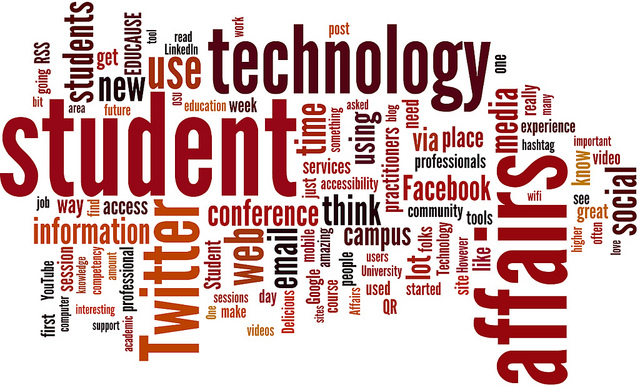
Photo courtesy of Eric Stoller (http://ericstoller.com/blog/category/technology/)

I have a job that combines two of my interests – student affairs and technology and the NASPATech conference is the only one I have ever attended that combines both. I have been to technology conferences but never in the context of student affairs.  I am excited to meet the folks the student affairs professionals and students I have met through social media (twitter via #sachat, #satech, facebook, and linkedin) in real life.  I am also excited to learn how other organizations and professionals utilize technology in student affairs beyond the IT perspective.  While my formal position is in IT leadership, I do consider myself as a student affairs professional first who works with technology and not a technologist who works in student affairs, having spent almost 20 years in students affairs in multiple capacities, including non-technical roles.

In this transformational period in higher education when technology has become an integral part of every function in the university and consumerization of IT has changed the technology landscape, the role of IT department and professionals are changing. In addition to the role of technology providers, IT departments must now play the role of brokers, playing the role of consultants between departments and vendors, campus units within and outside of student affairs as the push for combining services to cut cost continue, and with other campuses as collaborations between campuses expand. In addition to having to adopt a new role, there is also the challenge of having to keep up with the faster pace at which technology is introduced and the expectations of our customer that go along with it.

IT is often recognized as a utility, providing the network/server infrastructure, software and services. Given the scarce resources and dwindling budgets, the challenge of “keeping the lights on” by providing reliable and secure services while being innovative is very difficult. However, in my opinion, IT must go beyond being a utility provider and become a strategic leader by embracing new technologies and practices along with the expectations/attitudes and apply them in the context of the mission of our university and student affairs. To be able to do this, IT leadership must not only continue to understand the current/future needs of  our customers, but to also learn from the experience of others,  and to be aware of relevant technology trends and consider them in our strategic planning.

When NASPATech was announced a few months ago, I was not sure if my department would have the funds that would allow me to attend the conference and so I offered to review some program proposals. I also spoke with Joseph DeSanto Jones who was kind enough to spend some time sharing the purpose of this conference as well as to listen to my thoughts on student affairs and technology. I realized after reviewing the proposals and from my correspondence with Mr DeSanto Jones that this conference was too important for me to miss. I wanted to come, not only to meet the folks I’ve met via social media, but also to understand the current/future needs of our customers, learn from the experience of others, and to be aware of future trends.

For those at the conference, I would love to be able to share our experience/ideas on student affairs, either technology or in general. Whether you’re here or joining us via social media backchannels, what would you hope to get out of this conference?


Mobile General Resources

[tabs title=”” active=1 event=”click”]
[tab title=”General Guide:”]
[hungryfeed url=”http://www.diigo.net/rss/user/Joesabado/blog_mobile_general” feed_fields=”” template=”3″ link_target=”_blank” max_items=15]
[/tab]
[tab title=”Higher Ed:”]
[hungryfeed url=”http://www.diigo.net/rss/user/Joesabado/blog_mobile_hied” feed_fields=”” template=”3″ link_target=”_blank” max_items=15]

More articles bookmarked here….

[/tab]

[tab title=”iPad:”]
[hungryfeed url=”http://www.diigo.net/rss/user/Joesabado/blog_mobile_ipad” feed_fields=”” template=”3″ link_target=”_blank” max_items=15]
[/tab]

[tab title=”Mobile Learning:”]
[hungryfeed url=”http://www.diigo.net/rss/user/Joesabado/blog_mobile_learning” feed_fields=”” template=”3″ link_target=”_blank” max_items=15]
[/tab]

[/tabs]


Web Development Resources

[tabs title=”” active=2 event=”click”]
[tab title=”General Guide:”]
[hungryfeed url=”http://www.diigo.net/rss/user/Joesabado/blog_web_general” feed_fields=”” template=”3″ link_target=”_blank” max_items=25]
[/tab]
[tab title=”Higher Ed:”]
[hungryfeed url=”http://www.diigo.net/rss/user/Joesabado/blog_web_highered” feed_fields=”” template=”3″ link_target=”_blank” max_items=25]
[/tab]
[tab title=”Development:”]
[hungryfeed url=”http://www.diigo.net/rss/user/Joesabado/blog_web_dev” feed_fields=”” template=”3″ link_target=”_blank” max_items=25]
[/tab]

[tab title=”Accessibility:”]
[hungryfeed url=”http://www.diigo.net/rss/user/Joesabado/blog_web_accessibility” feed_fields=”” template=”3″ link_target=”_blank” max_items=25]
[/tab]

[tab title=”Testing:”]
[hungryfeed url=”http://www.diigo.net/rss/user/Joesabado/blog_web_testing” feed_fields=”” template=”3″ link_target=”_blank” max_items=25]
[/tab]
[/tabs]


New School Year, New Opportunities – Exciting Times Ahead!

School year just started and I am excited, really excited and optimistic about the prospect of what my team and my organization can accomplish this year. We’re going through perhaps the biggest project our department has ever undertaken, the conversion of our mainframe-based student information system to .net environment.  This project is in addition to multiple enterprise projects throughout the entire Student Affairs division. With the decreasing budget and changing demands and expectations of our customers, technology have become more central to the operations of the departments. Personally for me, I am excited with the challenge and opportunities of  merging consumer technologies (social media, cloud computing, mobile) with enterprise IT. I think the last time I saw this much shift at work is back in the mid-1990’s with the advent of the web.  There were paranoia about security, employees wasting time on the web, or if web was of even any value to  our organization. But just as I am seeing the same fears and concerns, I also see the same curiosity,  grassroots adoptions and even some level of  formal institutional adoptions of these  consumer technologies. The reality is that the demographics of those we serve in student affairs have changed and along with these changes are the expectations of more agile, more open systems.The students we serve are far different from those in the 1990’s. Our students grew up with technologies that we did not even envision back then. The rise of social media as we know it now, arguably, could be traced back to when friendster came to existence in 2002.  The creation of facebook in 2004 and twitter in 2006 further changed the social media landscape. With the increased and more robust wireless infrastructure and cheaper mobile devices, the way our society communicate is far different.

I wrote a blog post a few months ago that for social media to thrive in our institution, it has to be formally adopted.  Since then, our organization has created a formal position to coordinate divisional efforts to advance the adoption of consumer technologies.  Just as I had suggested in the same blog post, our organization has created a productivity/security group composed of individuals representing different perspectives to properly assess the integration of these technologies for business use and to address the challenges of accommodating the needs of individual users for flexibility with the needs of the enterprise.

In addition to social media, my team has begun to explore and develop mobile web sites. Using the UCLA Mobile Framework, we are exploring how we can use it within our existing content management system. Personally, I have learned a lot the last few months on the principles of mobile web development.  I truly believe mobile devices has begun and will continue to significantly alter how universities do business.  By taking advantage of the features of mobile devices such as geolocation, multiple inputs (QR Codes, NFR, location, gestures) and the fact that they are widely available even in the poorest sections of the world, in my opinion, more and more business transactions will be conducted via mobile devices.

Just as it was in the mid 1990’s for me when I woke up with a book about web development in my hand and go to sleep with it, going to sleep at 4 am, spending every night learning about how to develop web applications, I find myself in the same situation now. I wake up every morning to find some new knowledge via social media, new ideas I want to research, new applications I want to build. I go to sleep with ideas in my mind on what technologies mean to me, to my work.  It truly is an exciting time and I’m just enjoying the ride!


Facebook as a Model for Business Agility?

The agility at which facebook can make changes is something I can admire. In creating company this big, facebook is not going to please everyone, but led by Mark Zuckerberg who at times is faulted for his naivete because of his young age – he has optimism and energy on his side. As a line in the Social Network movie says “You don’t get to 500 million friends without making a few enemies.” Facebook, in my mind, represents a new breed of consumer-driven organization who must continually adapt at a very high rate of change to satisfy their stakeholders. I realize that arguments have been made that facebook changes are made for the sake of revenue and to maximize advertising, etc and not for the sake of customers. That is most likely true. However, even with that argument, I think that facebook must make changes that will not completely upset its customer base as revenue would then suffer. Consider the following quotes attributed to another brilliant innovator, Steve Jobs:

  • “Sometimes when you innovate, you make mistakes. It is best to admit them quickly, and get on with improving your other innovations.”
  • “You can’t just ask customers what they want and then try to give that to them. By the time you get it built, they’ll want something new.”

Apple and Facebook, led by these two innovators are probably rare companies in that they are able to define their products and services to whatever visions they have set, making mistakes along the way, yet are able to survive and even thrive.

As a facebook user, I sometimes get annoyed with the changes. Specifically with the latest ones released yesterday which makes the site looks very cluttered with all the different functions I can’t even name. It’s beginning to remind me of the cluttered myspace. However, as someone who is in a technology leadership position at a university, I sometimes envy how facebook can seemingly introduce changes overnight without having to go through committee approvals. This is not to say that the need for approval process and committees are all bad given security, policy and legal constraints that must be considered when introducing new technologies like social media. It is those instances when “paralysis by over analysis” cripple a project that bothers me a lot. Finding balance between making sure we are not introducing high risk but at the same time have the room to innovate is a challenge.

One of the guiding principles I have applied in my career is from a mentor I admire so much, the Vice Chancellor for Student Affairs  at UCSB – Dr. Michael Young. He told me way back when I was just starting my career that “I’d rather have you continually moving forward, making mistakes along the way, than stagnate.

One of the challenges I face at work (and life) is determining when to apply the principle of  “it’s easier to ask for forgiveness than permission”.  Looking back at what I have been able to accomplish throughout the years as a developer dating back to 1998 with our university’s campus calendar of events to the numerous applications I’ve built after, I wonder how much of it I would have even built if I had to ask for permission and if I had to prove the value of every single one of them every single time.

Do you agree/disagree with the idea that universities can learn from facebook or are we just different organizational models with different goals, stakeholders and customers?


  • Archives

  • Copyright © 1996-2010 Joe Sabado - Higher Education & Technology Leadership. All rights reserved.
    iDream theme by Templates Next | Powered by WordPress