Student Affairs

Student Affairs Research

[tabs title=”” active=1 event=”click”]
[tab title=”History:”]
[hungryfeed url=”http://www.diigo.net/rss/user/Joesabado/blog_sa_history” feed_fields=”” template=”3″ link_target=”_blank” max_items=15]
[/tab]
[tab title=”Student Dev Theories:”]
[hungryfeed url=”http://www.diigo.net/rss/user/Joesabado/blog_sa_student_dev” feed_fields=”” template=”3″ link_target=”_blank” max_items=15]
[/tab]

[/tabs]


NASPATech – A Student Affairs IT Pro’s Perspective

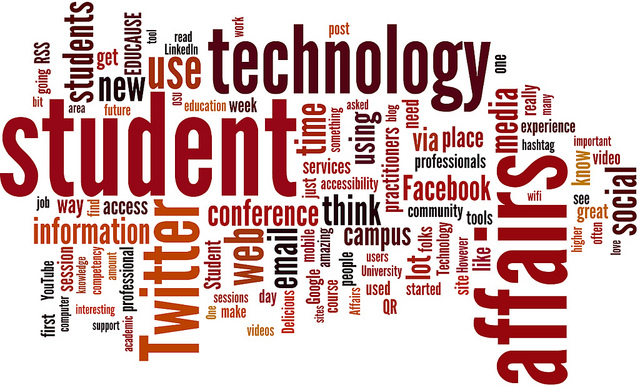
Photo courtesy of Eric Stoller (http://ericstoller.com/blog/category/technology/)

I have a job that combines two of my interests – student affairs and technology and the NASPATech conference is the only one I have ever attended that combines both. I have been to technology conferences but never in the context of student affairs.  I am excited to meet the folks the student affairs professionals and students I have met through social media (twitter via #sachat, #satech, facebook, and linkedin) in real life.  I am also excited to learn how other organizations and professionals utilize technology in student affairs beyond the IT perspective.  While my formal position is in IT leadership, I do consider myself as a student affairs professional first who works with technology and not a technologist who works in student affairs, having spent almost 20 years in students affairs in multiple capacities, including non-technical roles.

In this transformational period in higher education when technology has become an integral part of every function in the university and consumerization of IT has changed the technology landscape, the role of IT department and professionals are changing. In addition to the role of technology providers, IT departments must now play the role of brokers, playing the role of consultants between departments and vendors, campus units within and outside of student affairs as the push for combining services to cut cost continue, and with other campuses as collaborations between campuses expand. In addition to having to adopt a new role, there is also the challenge of having to keep up with the faster pace at which technology is introduced and the expectations of our customer that go along with it.

IT is often recognized as a utility, providing the network/server infrastructure, software and services. Given the scarce resources and dwindling budgets, the challenge of “keeping the lights on” by providing reliable and secure services while being innovative is very difficult. However, in my opinion, IT must go beyond being a utility provider and become a strategic leader by embracing new technologies and practices along with the expectations/attitudes and apply them in the context of the mission of our university and student affairs. To be able to do this, IT leadership must not only continue to understand the current/future needs of  our customers, but to also learn from the experience of others,  and to be aware of relevant technology trends and consider them in our strategic planning.

When NASPATech was announced a few months ago, I was not sure if my department would have the funds that would allow me to attend the conference and so I offered to review some program proposals. I also spoke with Joseph DeSanto Jones who was kind enough to spend some time sharing the purpose of this conference as well as to listen to my thoughts on student affairs and technology. I realized after reviewing the proposals and from my correspondence with Mr DeSanto Jones that this conference was too important for me to miss. I wanted to come, not only to meet the folks I’ve met via social media, but also to understand the current/future needs of our customers, learn from the experience of others, and to be aware of future trends.

For those at the conference, I would love to be able to share our experience/ideas on student affairs, either technology or in general. Whether you’re here or joining us via social media backchannels, what would you hope to get out of this conference?

Change Your Lenses, Change Your Perspective

Two weekends ago, I went to the driving range and I was hitting the balls pretty well. Then I decided to get contact lenses the following Monday because I wanted to start playing sports again since my eyeglasses had became too cumbersome. Last Sunday, with my new contact lenses, I went to the driving range and all of a sudden, I could not hit any shots at all. My swing just didn’t feel right. As I would set up and look at the ground, something felt different. The clubs look different and it seems my depth perception has changed. It took me awhile to figure out what has changed until I realized it was my contact lenses that was the difference.

As I took a break from hitting balls, it dawned on me that this concept of changing my lenses at work led to changing my perspective. I don’t mean lenses as in getting new eye glasses or contact lenses. What I mean is more of a mental lens. Before my wife went for a vacation to Seattle the beginning of September, I was getting a little frustrated trying to figure out how to promote the use of social media and cloud. Because of security and policy concerns, there were (still are) hesitation on the use of these technologies as business tools. Taking the vacation provided me some time to clear my mind and put on a new set of mental lenses which allowed me to look at the situation a little differently. I came back with the perspective that while the adoption of these technologies might be slower than I would like, I understand that it is a process that requires examining constraints and having to accept that our organizational culture and personalities will ultimately dictate the pace of adoption. I also came to realize that I can continue exploring the benefits of social media and cloud on my personal time knowing full well that the knowledge I acquire now will be of value to my organization at the time we are ready to come to terms with the risks/rewards of these technologies.


New School Year, New Opportunities – Exciting Times Ahead!

School year just started and I am excited, really excited and optimistic about the prospect of what my team and my organization can accomplish this year. We’re going through perhaps the biggest project our department has ever undertaken, the conversion of our mainframe-based student information system to .net environment.  This project is in addition to multiple enterprise projects throughout the entire Student Affairs division. With the decreasing budget and changing demands and expectations of our customers, technology have become more central to the operations of the departments. Personally for me, I am excited with the challenge and opportunities of  merging consumer technologies (social media, cloud computing, mobile) with enterprise IT. I think the last time I saw this much shift at work is back in the mid-1990’s with the advent of the web.  There were paranoia about security, employees wasting time on the web, or if web was of even any value to  our organization. But just as I am seeing the same fears and concerns, I also see the same curiosity,  grassroots adoptions and even some level of  formal institutional adoptions of these  consumer technologies. The reality is that the demographics of those we serve in student affairs have changed and along with these changes are the expectations of more agile, more open systems.The students we serve are far different from those in the 1990’s. Our students grew up with technologies that we did not even envision back then. The rise of social media as we know it now, arguably, could be traced back to when friendster came to existence in 2002.  The creation of facebook in 2004 and twitter in 2006 further changed the social media landscape. With the increased and more robust wireless infrastructure and cheaper mobile devices, the way our society communicate is far different.

I wrote a blog post a few months ago that for social media to thrive in our institution, it has to be formally adopted.  Since then, our organization has created a formal position to coordinate divisional efforts to advance the adoption of consumer technologies.  Just as I had suggested in the same blog post, our organization has created a productivity/security group composed of individuals representing different perspectives to properly assess the integration of these technologies for business use and to address the challenges of accommodating the needs of individual users for flexibility with the needs of the enterprise.

In addition to social media, my team has begun to explore and develop mobile web sites. Using the UCLA Mobile Framework, we are exploring how we can use it within our existing content management system. Personally, I have learned a lot the last few months on the principles of mobile web development.  I truly believe mobile devices has begun and will continue to significantly alter how universities do business.  By taking advantage of the features of mobile devices such as geolocation, multiple inputs (QR Codes, NFR, location, gestures) and the fact that they are widely available even in the poorest sections of the world, in my opinion, more and more business transactions will be conducted via mobile devices.

Just as it was in the mid 1990’s for me when I woke up with a book about web development in my hand and go to sleep with it, going to sleep at 4 am, spending every night learning about how to develop web applications, I find myself in the same situation now. I wake up every morning to find some new knowledge via social media, new ideas I want to research, new applications I want to build. I go to sleep with ideas in my mind on what technologies mean to me, to my work.  It truly is an exciting time and I’m just enjoying the ride!


Maybe We Shouldn’t Call it Social Media

This post is about how we, social media advocates, can better effectively convince those who are not sold on the values of social media. It’s not a post that offers definitive answers, but more of just personal observation on this matter. As a reader, maybe you can offer some suggestions on how to approach this topic.

In my casual conversations where I share the values of  social media, or in formal meetings where we discuss how social media fits into our organization, I sometimes find myself faced with puzzled looks or skepticism about the value of these tools as they relate to our business needs. Unfortunately, just like golf, social media is one of those things in life where it’s hard to explain what it is, what the experience is about, until one actually swings the clubs or in the case of social media, actually use them. What I have observed though is that as much as I would like to speak about what it means to me, how I have greatly benefited from it as a big part of my professional development,  or how I have used it  in my various professional roles (as an org advisor, as a manager who must provide professional development for my staff, as a tech leader who looks at trends, etc), I’m still talking about me and in probably in the language/terminologies those I speak with probably do not fully understand.  This is like a developer  talking in techie jargon to a business user.  Ultimately, to be effective, I’ve found that I need to look at it from the other person’s perspective in the language they understand and what matters to them.

Instead of describing what social media is and what we can do with them (e.g. send short messages on twitter, post statuses in facebook, etc),  maybe talk about it in the context of our business and from the interests of who we are speaking with. I work in student affairs and what matters to the decision makers include the following topics: outreach, enrollment, retention, wellness, academics, quality of student life, student engagement. If we frame the discussion of social media in the context of the topics I mentioned, then I think we can be more effective in convincing those that do not see the potential benefits of social media.

How do you think we can be more effective in communicating the value of social media?


  • Archives

  • Copyright © 1996-2010 Joe Sabado - Higher Education & Technology Leadership. All rights reserved.
    iDream theme by Templates Next | Powered by WordPress