Student Affairs

What Are Your Self Limiting Beliefs?

I grew up believing that “challenging” authority (elders, teachers, bosses) was considered rude and disrespectful.  By default, those in authority should be respected. I went through half my life, even early on in my career following orders and keeping my opinions to myself because of this belief. I was not supposed to “make waves” as their are consequences. I think I have come a long way from that person who was too polite to voice his opinions.  It took me some painful experiences to realize I had to change my way of thinking. Whether these self beliefs from personal experiences or imposed by society, I think there’s value in re-examining our own self limiting beliefs for a more fulfilling life.

In his book Awaken the Giant Within by Anthony Robbins, he shared some stories of self limiting beliefs.  One example are adult elephants that are physically capable of breaking away from a chain links tied to posts but they don’t do so. This is because as young elephants, they were tied to the same chain links and when they tried to break away from them, they were not physically strong enough and so growing up, they were conditioned to not even try. How many opportunities in our lifetimes have we failed to take advantage of because of our own self limiting beliefs?

Roger Bannister broke the four-minute mile barrier on May 6, 1954. For years prior to that date, the general belief was that it was impossible to accomplish that feat. Thousands of runners have run faster than Bannister since he broke that barrier. As I read somewhere, “everything is impossible, until it is possible.”

As a student affairs professional, I wonder what self limiting beliefs we have as a profession that maybe preventing us from advancing, looking at our profession in a different light? In my role as a technologist intent on promoting the use of mobile web and social media, one of the biggest push back against using these technologies are the fear of potential FERPA/HIPAA violations, security breaches, disclosure of confidential information. As someone who is in the position of responsibility to enforce policies and guard student records as well as other confidential information, I am very aware of the consequences, including penalties that could result from these incidents. I remember having the same concerns expressed to me in mid 1990’s when I started building web sites or when email became the primary form of communication. I also remember a colleague who refused to acknowledge the possibility of using the web to conduct financial aid transactions because he felt the web will never be as robust as desktop applications.

New technological advances bring higher expectations from our customers for our institutions to provide services the way they are accustomed to getting in their personal lives via consumer technologies.  How long, as a profession, can we continue to cling on to our self limiting beliefs of “that’s how we have always done it” or our skepticism against new ways of providing services to our students?

At a personal level, what are some beliefs you may have that are self limiting? How about student affairs?

Welcoming a New Colleague – Building Relationship


On your current or last job, what kind of welcome did you receive from your supervisor? Did he/she take the time to spend hours with you on your first day to go over your department, projects? How about take you around your campus, take you to lunch and introduce you to your co-workers?

One of my co-workers welcomed a new member to his team this week. He is busier than most people I know, working on multiple projects and managing a team with several members.  Despite his busy schedule,  he took a big part of his day to welcome  his new colleague, patiently explaining how our organization works and current projects we are working on. He works right next to my office and so I could over hear everything he was sharing and I kept on telling myself how I could be more patient like him. I saw him sometime that afternoon and he told me that he had taken his new colleague around the campus, even going to the highest floor of our library, one of the tallest building on our campus so he can show him a view of the entire campus, including the lagoon and the Pacific Ocean nearby. He also walked with him around the small town adjacent to our campus where students live.  He then took him to lunch where he and I, along with some of our colleagues frequently eat.

I thanked him for all that he had done to welcome our new colleague that day as I know all the things he took time to do was a start of their working relationship, a positive one. Taking time to welcome new employees or just to chat with colleagues we’ve worked with for years seems such a simple thing to do yet I know I don’t do often enough. The actions of my co-worker in making sure his new staff feels welcomed reminds me of this. I had made a commitment when the year started to spend more time with all of my staff, even if just having lunch or coffee from time to time to connect with them, exchange stories beyond what they’re working on.

What have you experienced or seen in your career we could all do to make new colleagues feel welcomed?


1 Comment more...

My Perspective on IT Leadership for 2012

I welcome 2012 with optimism and with gratitude! I am in a middle of a revolution that’s bigger than technology. I am not sure how to define it, but society is changing fast, in part brought on by technologies like social media and mobile.  The last time I experienced this change so rapid and exciting was in the mid 1990’s when web became mainstream.  I found 2011 to be a year of transformation for the  IT organization I work for and based on general observations, this seems to be true for IT organizations in general. As one in a leadership/management position of having to maintain legacy systems,  accommodate the changing needs of our customers and the consumerization of IT, it was a year wherein I had to spend an average of 3 hours at night learning/thinking about social media, mobile and how our roles as an IT organization are changing.  I spent some time thinking about how technology will transform our society in general and specifically about student affairs, the area of the university I work in. I learned many lessons along the way, not just about technology but how I will approach my leadership role moving forward.

(continue reading…)


Student Affairs as Social Business

“Even though we’re operating with the best of intentions in social media, we are still operating from silos. The customer however, does not see silos, they see the company as one.” – Brian Solis, The End of Business as Usual.

Social Business graphic

credit - socialware.com

I have only been active on popular social media sites like facebook and twitter the last year or so and much of what I have read about how organizations use social media in that time revolves around marketing, communicating and engaging with customers, those external to organizations. However, in the last few months, I have noticed more mentions of social business, which Michael Brito describes as “any company that has integrated and operationalized social media within every job function (and process) internally.” IBM describes social business as “one that embraces and cultivates a spirit of collaboration and community throughout its organization—both internally and externally.” Several companies have already embraced this concept per this report Research Summary: Introducing The 43 Use Cases For Social Business (Social Enterprise) by Constellation Org. Advocates of social business including Mr. Brito, Mr. Owyang, Mr. Solis and Mr Bradley/Mr MacDonald all emphasize the following points in some form: 1) social business goes beyond technology, it involves people, processes and culture 2) embracing the power of collective wisdom from internal employees and customers and 3) holistic approach – no single unit owns social efforts and customer service belongs to everyone in the organization.

(continue reading…)


Why We Need to Redefine “Face to Face” Communication

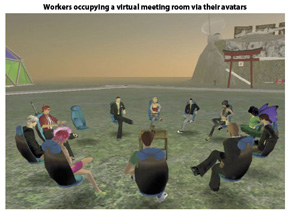
Virtual Meeting with avatars

credit - internetsiao.com

A story about a tech firm CEO banning the use of email for internal communication has been a topic of discussion around social media the last couple of days. Reported by multiple news agencies and websites, the title centers around the idea of “banning email” which is certainly a more sensational headline than the the fact that as the story notes,  “instant messaging and facebook-style interface” is replacing email for internal communications in the company.

This story reminds me of how in the last few years, some of the ways we, in our higher ed, communicate have changed. In addition to email and phones, instant messaging and video conferencing have become additional means to communicate in our daily work.  A few years ago, when we say face to face communication, that most likely meant two or more people looking at each other in the same physical room.

The concept of face to face communication is particularly relevant in student affairs and how we conduct our work.

I have heard some concerns about role of technology in how we interact with students and colleagues and how technology cannot/should not replace face to face interactions. However, our definition of face to face will probably have to change moving forward. Consider that some of our online students may never step onto our campus or that we will need to meet with students like international/out-of-state students before they even arrive on campus. With bigger bandwidth and the availability of wireless networking, face to face communication now carries a different meaning, to me anyways.

With Google+ Hangout, Skype via Facebook and other various free services available, the use of video conferencing for one-on-one and group communications will continue to become a bigger part of how we all communicate. Here are some examples I have seen video conferencing used on our campus:

  • My team of developers located on our campus use their webcams and Microsoft Communicator/Live Meeting to communicate daily with a couple of their colleagues who telecommute from different cities
  •  Our Admissions office staff use Adobe Connect to hold one-on-one and one-to-many virtual advising sessions with prospective students
  • A professor uses the same product to hold review sessions with his students
  • I had an informational interview using Skype and iphone with a graduate student from a different state
  • Students use TokBox to have multiple conversations
  • Video interviews of job applicants
  • A presentation on Identity Development Theories by a professor from San Diego State University to undergraduate students
  • Vendor presentations

A decade ago when the web became an important part of how we communicate with students,  along came  expectations of information/services available 24×7 and universities had to accommodate them. In these days of social media and more advanced technology, which include 2 way video communications, students will probably start expecting universities to use the tools and communicate they way they do in their personal lives.   In the future, what students define as face to face communication may be different than what we used to define it pre-social media days.

How do you see the way we communicate in our workplace  changing now and in the future?


  • Archives

  • Copyright © 1996-2010 Joe Sabado - Higher Education & Technology Leadership. All rights reserved.
    iDream theme by Templates Next | Powered by WordPress