Author Archive

A Painful Reminder of My Able-Bodied Privilege

I was reminded of my privilege as an able-bodied person to have the ability to freely walk around when I could not walk last week.  This was all because of a severely sprained right foot.  I had to get an X-Ray to make sure none of my bones were broken.  For the last few days, I’ve been hobbling around, even dragging my leg,  trying to go up and down our stairs at home and going from the parking lot to our buildings at work. I started to notice certain things like how far the elevator is from the parking lot, even from the disabled parking spots. It took me a little longer to get from one meeting to another. I had to ask one of my colleagues to bring some water so I can drink some pain medicine.

My disability is temporary. In a couple of days, I should be walking around again with no pain (I hope), but this sprained foot did provide me a reminder to check my able-bodied privileges.

There are many privileges we are afforded in life and sometimes I know I don’t always appreciate them.  This painful albeit temporary experience certainly reminded me of that.


Practice What We Preach – Do No Harm When We Tweet

This is as much as reminder to me as to anyone else I connect with on twitter or on other social media platforms.  Let’s practice what we preach when we tell others to practice kindness and be the leaders we’re supposed to be in our professions and our communities.

I was about to tweet something sarcastic and derogatory during the Oscar Award show,  about to join others who were mocking some celebrities,  but I caught myself and stopped.  Are we not to model the behavior we want our students and colleagues to be? From time to time, I see tweets that remind me to “check your last 10 tweets. Would someone hire you based on those tweets?”  Even the benign sarcasms can be misinterpreted on social media.  Look, I’m no Kristen Stewart fan when it comes to her acting but the tweets that came across my timeline were not the most positive, even mean. I actually felt bad for her as she limped on stage.  She may never see those tweets but some of the students or friends we’ve been preaching to about the proper use of social media may.

I’ve been guilty of not being so nice on social media either, not on purpose, but inadvertently.  If you catch me acting on social media in a way that’s not appropriate, make me accountable by calling me out .  Let’s make a commitment towards practicing what we preach by modeling good and acceptable behaviors we expect our students and others who are looking at our actions can follow.


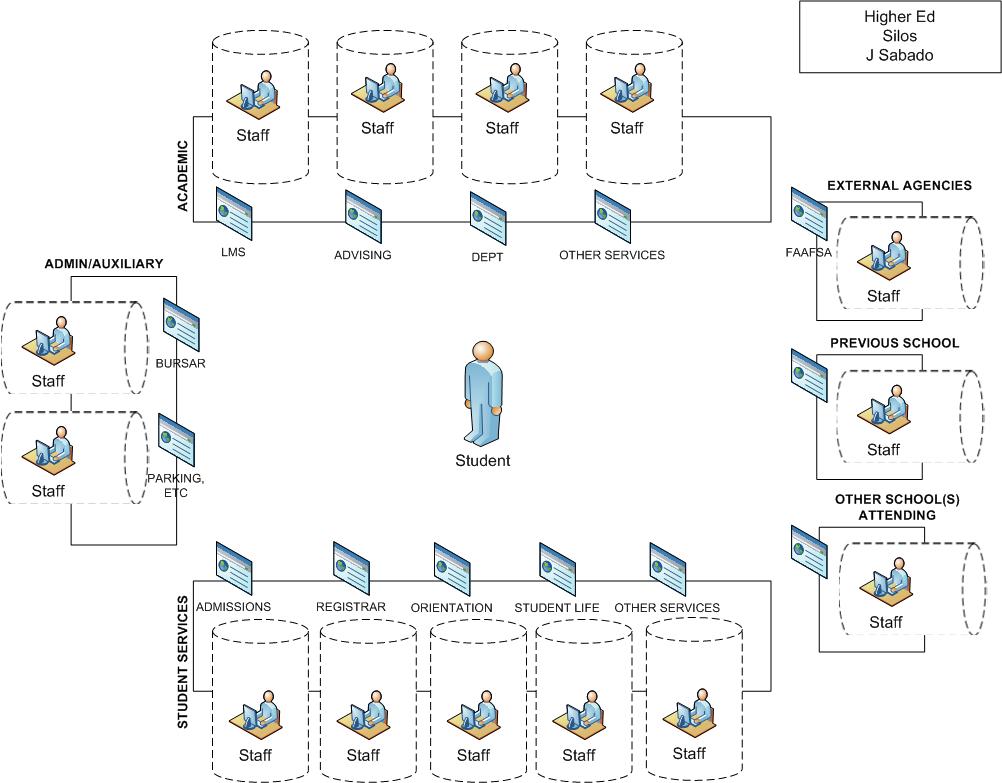
Higher Education Silos

I wonder if this is how some students see the university?


Higher_ed_silos


Being A Team Player

encourage-team-work1

“Team wins championship!” says Vice Chancellor for Student Affairs at UCSB, Dr. Michael Young.  He’s a big believer and practices that ideology. It’s also something I try to practice.  There have been some work projects I would have loved to be involved in significantly, but there are other colleagues who are better fit because of their expertise and experience and that I’m also working on some other projects.

I have come to realize that even as someone who may not be involved in these projects, I am part of a team and we are all in this together.  Using team sports as an analogy, sometimes we are on the starting unit and sometimes we will come off the bench but regardless, we could contribute in several ways:

  • Be ready to “sub(stitute)” when called upon.  Your time maybe when the ball is tipped or maybe late in the  first quarter, fourth quarter or anytime in between.  Have the mentality of willingness to accept any responsibility given to you and be ready to perform anytime.
  • Provide moral support.  I love seeing bench players engaged while they are not on the court and how happy they get when their teammates do things well on the court. I also love players who provide encouragement when their teammates are not performing so well.  Providing moral support also means doing the “small things”. It could be that one encouraging email to a co-worker or offering to take on a task others may not have time for. I think this is even more important as a leader. I remember my former department director moving papers and other materials from a cubicle to help out with one of my colleague’s move to another office. She was a busy person and while she didn’t do these “small tasks” of cleaning cubicles often, it showed me and my colleagues she was willing to do what was needed to be done.
  • Provide feedback when appropriate. Players sitting on the bench have different perspectives than players who are on the court.  Offer feedback when appropriate towards the goal of improving the team performance.
  • Learn for future projects. While you may not be involved in this current game (project),  learn for future projects when you will be called upon to lead.  I think time is a very rare commodity when it comes to learning, so when I have “down times”, I use them to learn on the side like reading materials related to projects on our department.
  • Develop and adopt “team first” mentality. I admit that in the past, the source of frustration for me when not involved with major projects was ego.  I like being part of the action and I want to be involved in the decision making process. However, what I’ve come to realize is when I have the “team first” mentality, I become more positive and I am more productive and effective in my job.
  • Eliminate “he/she should” and change to “I could” mentality.  I think we can all play the role of “Monday morning quarterbacks” and thinking we could do things better. When you catch yourself criticizing the performance of others like “He should be more communicative”, change it to “I could be more communicative.” By shifting our attitude to what and how we can contribute and how can improve ourselves instead of focusing on the shortcomings of others, we can add value to our teams.

According to an African proverb,  “If you want to go fast, do it alone. If you want to go far, go together.” From experience, I think this is a very wise idea to practice.

Image credit: http://blogordietryin.wordpress.com/2012/05/24/progress-blog-or-die-tryin-group-or-team/

MOOC “Meltdown” or a Learning Experience?

Given the debate about the legitimacy of Massive Open Online Course (MOOC) as it relates to effective learning, the “failure” of the Coursera course – Fundamentals of Online Education was a hot topic days after it had to be suspended due to technical glitches and some confusion about the design of the class. I was enrolled in the course, my first MOOC course, and so I was disappointed the class could not continue. I was looking forward to the online learning experience with folks from countries such as India, Poland, South Africa and other parts of the U.S.

While critics of MOOC and articles such as this can certainly use this class as an evidence on the shortcoming of MOOC, I think it provides a huge potential for growth on how to proceed with designing and implementing online learning. I say potential because “failure” in itself does not lead to learning, but it does provide opportunities to reflect and improve on the instructional design and technologies. As a matter of fact, I think Coursera and other MOOC designers, after having to deal with criticisms and embarrassments, can point to this course as a positive milestone in the long run.

I was reading a book called Switch recently which talks  about growth mindset. This is the mentality of accepting challenges despite the risk of failure.  On the outside looking in, I can only imagine the infrastructure, resources, and thoughts that make MOOCs happen. Certainly, given the number of students participating in these courses and the sentiments filled with hyperbole from both opponents/supporters of MOOCs, mistakes and criticisms are magnified.  However, personally, some of my biggest growth have come from what I considered at the time they happened as failures. I wrote in this post the value of making mistakes.

I have great respect for companies and instructors who are pushing the boundaries when it comes to exploring new ways of learning. I look at MOOC, not as a substitute for brick-and-mortar higher education institutions, but rather a supplement to accommodate the needs  traditional universities cannot meet. I hope this course will be offered again and Dr. Fatima Wirth be given a second chance to share her expertise.

  • Archives

  • Copyright © 1996-2010 Joe Sabado - Higher Education & Technology Leadership. All rights reserved.
    iDream theme by Templates Next | Powered by WordPress